

NEWS AND ANNOUNCEMENTS RELATED TO TRANSPORTATION
MATS FY 2023-2026 Transportation Improvement Program is Posted for Public Comment
PUBLIC NOTICE
Public Comment and Open House Regarding MATS’
2023-2026 Transportation Improvement Program
The Midland Area Transportation Study (MATS) is seeking public comment on the proposed 2023-2026 Transportation Improvement Program. The TIP outlines future programmed improvements to the area’s transportation system. It is available for review on the MATS website at www.midlandmpo.org. The public can submit comments to MATS through website, by mail, e-mail, or phone - 989-832-6812 by May 31, 2022.
An “Open House” to discuss the TIP list and draft TIP Report will be held on Wednesday, May 11, 2022 from 5:00 PM to 7:00 PM in the Atrium of Midland County Services Building, 220 W. Ellsworth Street. Pursuant to the Americans with Disabilities Act, aids/services may be requested to participate in the meeting.
View and comment on DRAFT MICHIGAN ENVIRONMENTAL JUSTICE SCREENING TOOL (MIEJSCREEN)
MiEJScreen is an interactive mapping tool that identifies Michigan communities that may be disproportionately impacted by environmental hazards. The map allows users to explore the environmental, health, and socioeconomic conditions within a specific community, region, or across the entire state.
These data sets can be viewed individually or combined into a final MiEJScreen score that allows users to understand how communities experience environmental justice impacts relative to others. These results are depicted in the form of maps so that different communities can be compared to one another.
A census tract with a high score is one that experiences higher pollution burden and vulnerability than census tracts with low scores. MiEJScreen ranks census tracts based on data that are available from state and federal government sources.
View the home page here:
MATS Releases Draft Long Range Transportation Plan for Public Review
MATS has released the public review draft of its long range transportation plan Towards 2045. The draft can be found here.
This update to the long range transportation plan (LRTP) outlines regional goals and objectives that will guide the investment of nearly $1 Billion into transportation projects proposed through 2045 in Midland County as well as Williams Township in Bay County and Tittabawassee Township in Saginaw County.
Every five years, the LRTP is updated. The first LRTP for MATS, which was established in 2013, was completed in 2017. The new LRTP will include a 23-year planning horizon and will take into account demographic and economic developments as they relate to transportation demands, as well as climate change, resilience, and environmental justice policies. In addition, the LRTP will be the first version of the plan to fulfill Federal Performance Management standards.
The LRTP must be fiscally limited, and transportation investments are based on regional budget predictions throughout the Plan's horizon. The plan is based on regional goals and objectives, and it aims to extend the life of existing infrastructure by employing asset management principles. The LRTP incorporates a range of transportation modes to efficiently serve the region in a way that promotes environmental sustainability, accessibility, economic growth, and improved quality of life for residents.
The public is encouraged to review the document, and provide comments here, via email at info@midlandmpo.com, by phone at 989-832-6333 or by mail at 220 W. Ellsworth St., Ste 326, Midland Michigan 48640.
State of Michigan announces bipartisan budget agreement
FOR IMMEDIATE RELEASE
September 21, 2021
Contact: Press@Michigan.gov
Kurt Weiss, Weissk1@michigan.gov
Gov. Whitmer and Legislature Come Together on Bipartisan Budget that Puts Michiganders First Without Raising Taxes
Budgets includes $500 million deposit into rainy day fund, grows workforce development programs, expands childcare, builds up bridges and water infrastructure
LANSING, Mich. — Governor Gretchen Whitmer celebrates bipartisan budget agreement as the legislature moves budget bills for Fiscal Year 2022, which begins on October 1. She plans to sign the bipartisan budget into law before the end of the month. The budget provides strong investments for the state’s economy, enhances childcare for Michigan’s working families, invests in education and the skills needed for Michigan’s workforce, protects our health, prioritizes cleaning up our water and environment, and rebuilds our infrastructure and crumbling bridges.
The General Fund budget will total $11.8 billion, and when combined with the already signed School Aid Budget of $17.0 billion ($2 billion from federal sources), the full budget will provide $26.8 billion in state spending. With federal funding and other restricted revenues included, the full budget will total just under $70 billion. In July, Gov. Whitmer signed the School Aid budget, providing historic investments in K-12 education and increasing access to preschool, marking the end of a 27-year journey to close the funding gap between school districts.
“I am thrilled that the legislature and I were able to come together to agree on a bipartisan budget. Our collaboration is a testament to what’s possible when we work together and put our families, communities, and small businesses first,” said Governor Whitmer. “The budget will make the biggest-ever one-time deposit into our rainy day fund, repair or replace nearly 100 bridges, expand childcare to 105,000 kids at low or no-cost, replace lead service lines, permanently raise pay for direct care workers, and do so, so much more. I look forward to continuing in the spirit of collaboration to spend the billions in federal dollars we have available to us from the American Rescue Plan and the billions more we are expected to receive from the bipartisan federal infrastructure bill. When we come together, we are capable of making incredible progress and I am proud that we got this done.”
“I am proud of this budget and the collaboration with the legislature to create a spending plan centered on transformational investments that will drive Michigan’s continued recovery,” said State Budget Director David Massaron. “This budget is going to help Michigan emerge as an even stronger state and it provides the type of investments that will foster real and lasting improvements to support Michigan’s families and businesses.”
The budget will provide a series of investments to help Michigan’s economy, including lowering the costs and expanding the access of childcare for working families. The funding plan includes:
· $108.1 million that makes 105,000 more children eligible for child care by increasing income eligibility to 185 percent of the federal poverty level through fiscal year 2023, then 160 percent ongoing in the following fiscal years.
· $13 million to waive parent copays for childcare through fiscal year 2022.
· $158 million for an ongoing 30 percent rate increase for childcare providers, with an additional $222 million for a temporary rate increase.
· $117.4 million to pay for enrollment in childcare through fiscal year 2023.
· $36.5 million over 3 years to expand the number of childcare spaces for infants and toddlers.
· $700.7 million for stabilization grants and another $100 million for startup grants for childcare providers, including technical assistance and facility improvements.
· $30 million for a one-time $1,000 bonus for childcare staff.
· $100 million for community revitalization and placemaking grants to support economic development in local communities.
“This relief is coming not a moment too soon – today’s budget will be a lifeline to the child care providers who were struggling to make ends meet even before the pandemic,” said Annemarie Valdez, President of First Steps Kent. “These funds will make it possible to stabilize not only the child care industry, but will help bring Michigan parents back into the workforce, which will in turn alleviate pressures on our economy overall. Thanks to the Governor and State legislators for negotiating a deal that puts families first.”
The budget will also provide direct support for education and skills training to help address the skills gap and provide Michigan employers with the talent needed to move the economy forward. Investments will include:
· $55 million for the Reconnect program to provide a tuition-free pathway to an in-demand industry certificate or associate degree for Michigan adults age 25 and older to help Michiganders get the skills they need to compete for a good-paying, in-demand job.
· $25 million for the Futures for Frontliners scholarship program that pays for frontline workers to attend local community college tuition-free.
· $40 million for the Going Pro program to expand employer-based training grants that result in industry-recognized credentials and certificates to help raise wages for workers and help employers fill job openings.
· $6 million for wraparound supports for Reconnect or Futures for Frontliners to remove barriers to degree completion.
· $8 million for pre-apprenticeship/apprenticeship training programs that will expand Michigan’s talent pool in the construction and building trades.
· $1 million for Focus: HOPE to support workforce development, youth development, and community empowerment and advocacy programs.
· Increased base funding of 1 percent for operations at universities and community colleges, with a one-time 4% increase in funds to help keep tuition costs down.
“Michigan is ready to work, and we have good-paying jobs in the skilled trades that need to be filled,' said Cheryl Sanford, CEO of the Michigan AFL-CIO Workforce Development Institute. "This budget's use of resources to help provide apprenticeship readiness programming helps close that skills gap, connects those in hardship with access to opportunity, and ultimately builds financial sustainability for working families across Michigan."
“The resources provided in this budget for Michigan Reconnect and Futures for Frontliners are vital for Michigan’s community colleges and their role in moving our state forward,” said Steve Robinson, Ph.D., President of Lansing Community College.
The budget will also make strong investments in the state’s infrastructure to provide additional resources necessary to make needed repairs and replacements, including:
· $196 million for local bridge bundling to repair or replace nearly 100 crumbling bridges in serious and critical condition.
· $14.3 million to help local governments prepare for climate change and extreme weather, including flooding and coastal erosion.
· $19 million for dam repairs and replacements to mitigate flooding and hazards caused by dam malfunction.
· $3 million for the Michigan Infrastructure Council.
“Investing in infrastructure just makes sense for Michigan,” said Tom Lutz, Executive Secretary-Treasure of the Michigan Regional Council of Carpenters and Millwrights. "I applaud Governor Whitmer and the Legislature for coming together on a budget that will fix our long-crumbling bridges, roads and other critical infrastructure with a plan that will create jobs and put hard working men and women to work all across this state."
The budget will also fund key initiatives centered on the health of Michigan families, including:
· $460 million to give a permanent $2.35/hour raise to direct care workers who take care of our most vulnerable in nursing homes and beyond.
· $7.4 million to expand the Infant Home Visiting program for evidence-based home visiting services to at-risk families with infants born with substance exposure.
· $19.1 million for the MiChoice program expansion to provide alternatives to nursing home care and allow seniors to stay in their homes (increase of 1,000 slots).
· $6.7 million for the Sickle Cell Disease Initiative to cover the cost of treatment to around 400 adults and increase outreach and clinical capacity supporting the estimated 4,000 Michigan residents living with sickle cell disease, which disproportionately affects Black people.
· $8.4 million to reduce health disparities and expand the use of community-based navigators to enhance access to health coverage, and improve screening, data sharing and interoperability of existing data systems through the Michigan Health Information Network.
· $5 million for a pilot program to bring down utility bills for families by improving home weatherization and energy efficiency.
“Our direct care workers work hard every day, but have especially gone above and beyond over the past year,” said Robert Stein, Michigan Assisted Living Association. “We thank Gov. Whitmer for recognizing the value of direct care workers and supporting a wage increase.”
“The Sickle Cell Disease Association of Michigan (SCDAM) thanks Governor Whitmer for her leadership in the fight to address health care disparities,” said Dr. Wanda Whitten-Shurney, CEO/Medical Director of the Sickle Cell Disease Association of America, Michigan Chapter. “ASCDAM sits at the forefront of creating real systematic change in the care of individuals living with sickle cell disease. This much needed increase in funding will be instrumental in helping to improve the quality of life for patients across the state.”
The budget also focuses on the need to invest in our water and environment, including:
· $10 million to continue the replacement of lead service lines in Benton Harbor to provide access to safe drinking water.
· $15 million for the Emergency Drinking Water Fund to help the state address drinking water emergencies.
· $14 million to address PFAS and another $22 million to clean up contaminated sites across the state.
· $25 million to clean up the Western Lake Erie Basin by reducing phosphorus levels.
· $10 million for the Lead Poisoning Prevention Fund to help eliminate lead poisoning in homes by injecting private capital into lead remediation efforts.
· $5 million for the State Facility Green Revolving Fund which is a catalyst for energy efficiency and renewable energy projects at state facilities, helping reduce the state’s carbon footprint and save taxpayer dollars.
“This first round of funding for clean, efficient energy and safe drinking water includes a number of new, innovative initiatives and is a down payment on the significant costs we will have to pay to clean up contaminated sites across our state and protect our water,” said Nick Occhipinti, government affairs director for Michigan League of Conservation Voters. “Safe and clean drinking water is not a partisan issue, and we look forward to continuing to work with lawmakers and the Governor to ensure protecting our water and our health are priorities in the final budget and in upcoming investments our state will make with federal recovery aid.”
The safety of Michigan residents is also prioritized in this budget, with $7.3 million in increased funding to hire and train new corrections officers for the state’s prison system, and more than $800,000 in new funding for wellness initiatives for corrections employees.
Department of State Police investments include $3.8 million to expand the use of body cameras, $4.5 million for a professional development and training effort, $7.7 million for a trooper recruit school, $2.5 million for breathalyzer test replacements, and a $2 million increase in secondary road patrol grants.
The budget also provides $16 million for 911 system upgrades and $5 million to support local efforts to expand recruitment, improve training, and provide additional professional development to first responders.
Funding is also provided to improve and enhance technology systems across state government with $17.5 million in increased funding for the state’s information technology investment fund. Another $20 million is provided to protect state information technology systems from advanced persistent cyber threats to help ensure data doesn’t get into the wrong hands.
A two percent increase is provided for statutory revenue sharing payments to cities, villages, townships, and counties, and Constitutional Revenue Sharing is adjusted to reflect higher-than-expected sales tax revenues due to Michigan’s strong economic recovery. This is an increase of $71 million to local communities across the state to help fund police, fire and public safety.
The budget will also deposit $500 million into the Budget Stabilization Fund, bringing the total fund balance to nearly $1.4 billion, representing the largest rainy day fund balance in state history.
###
After Strong Opposition, OMB Rejects Change in Metropolitan Definition
The Daily Yonder reports here: After Strong Opposition, OMB Rejects Change in Metropolitan Definition (dailyyonder.com) that: The proposal would have raised the population threshold for a core city of a Metropolitan Statistical Area from 50,000 to 100,000. Ninety-seven percent of the public comments about the change were negative.

by Tim Marema
July 13, 2021
After overwhelming public opposition, the federal Office of Management and Budget has backed away from a plan to change the way it defines metropolitan and nonmetropolitan counties.
The proposal would have raised the minimum core-city size for a Metropolitan Statistical Area from 50,000 to 100,000 residents. The change would have reclassified 251 currently metropolitan counties as nonmetropolitan, based on current population figures. The affected counties contain a combined population of about 18 million. The change would have raised the nation’s nonmetropolitan population from about 46 million to 64 million.
Although the Office of Management and Budget (OMB) says its county-classification system is designed only for statistical purposes, the metropolitan/nonmetropolitan county designation is incorporated into an undetermined number of federal funding programs. Also, publications like the Daily Yonder use the county classification as a surrogate definition for rural. Even the venerable USDA Economic Research Service uses the nonmetropolitan classification as the starting point for much of its research on rural conditions.
The proposal to change the Metropolitan Statistical Area definition led to a national campaign to urge the OMB to abandon the change. The campaign helped prompt 734 comments on the measure. Ninety-seven percent of those comments opposed the redefinition.
The OMB’s inter-agency standards review committee subsequently withdrew its support for raising the population threshold for core-cities of Metropolitan Statistical Areas. The committee recommends a “delaying action” on the change and says there should be additional research and analysis on the issue.
Most of the comments on the proposed change cited the impact the redefinition could have on federal funding for rural and urban programs, the OMB document states. But OMB did not consider those concerns in its decision. “OMB establishes and maintains these [metropolitan and micropolitan] areas solely for statistical purposes,” the document states. “In reviewing and revising these areas, OMB does not take into account, or attempt to anticipate, any public or private sector nonstatistical uses of the delineations.”
The sign-on letter for the national campaign that opposed the redefinition of metropolitan areas said OMB needs to be more realistic about how federal agencies use the definitions.
“The proposed change to the MSA standards would not just be ‘statistical’ – it would have both financial and capacity consequences for rural places,” according to the sign-on letter. “Despite OMB’s insistence to the contrary, federal programs often use the OMB standards to inform definitions of ‘rural’ and ‘urban’ that influence eligibility requirements, allocation formulas, scoring criteria, and several other dimensions of [federal] program administration.”
In a press release, OMB said it would continue to study the metropolitan definition. A primary reason for raising the population threshold of core cities from 50,000 to 100,000 is that the definition has not kept pace with growth in the U.S. population, the press release states.
Five other small changes in the metropolitan classification system were enacted. These include eliminating special statistical areas used in New England, maintaining the use of commuting as a way to determine which outlying counties are part of a metropolitan area, making new provisions for how Puerto Rico is integrated into the county classification system, and other administrative matters.
Saginaw Road Bridge in Sanford Reopens After Flood

By Mallory Pearson
Published: Oct. 23, 2020 at 5:00 PM EDT
SANFORD, Mich. (WJRT) - The village of Sanford took another step toward normal on Friday, as the Saginaw Road bridge reopened five months after it sustained heavy damage from May’s flooding.
The small section of roadway is bringing people together in more ways than one.
“We all were here during the flood while the water was going over the top and we closed the road, and then we haven’t been able to travel over it since the flood so were super excited,” said Sanford resident Delores Porte.
The tight-knit village, which sustained some of the worst flooding damage in May, finally is reconnected with the bridge reopening.
“It’s very exciting to see everyone come out -- people came with flags, dogs, bikes,” Porte said. “So it’s just very fun to see everyone.”
The road is the main connection through town. With the fire department just at the corner, the reopening has been critical in their life-saving efforts.
“It’s about an extra seven to eight minutes. And that impact, last night, about a half mile from here we had a structure fire. It didn’t spread into the house because we came across the bridge and that made all the difference,” said Jerome Township Fire Chief Jerry Cole.
It’s been a tough few months for the village of Sanford, but residents say they’re taking every day one stop at a time and rebuilding to a new level of Sanford strong.
Clean-up also was underway Friday at the Sanford dam. Residents are encouraged to come and claim any of their property that may have been swept away by the May floods and trapped behind the dam.
Copyright 2020 WJRT. All rights reserved.
M-30 over the Tittabawassee River bridge repairs in Edenville start Aug. 3
Fast facts:- MDOT will administer an emergency contract to repair the existing bridge piers for M-30 over the Tittabwassee River. - Fisher Contracting has been awarded the emergency bid at $1.2 million and will begin work Aug. 3.- MDOT expects to reopen the bridge to traffic by mid-September.
August 3, 2020 -- The Michigan Department of Transportation (MDOT) has awarded an emergency contract to begin repairs to M-30 over the Tittabawassee River in Edenville. The bridge sustained extensive damage to the piers and bridge approach during flooding in May.
In late June, an emergency contract was issued to begin debris removal at the site. Following debris removal, crews were able to inspect the existing structure and determine what repairs were necessary and feasible to reopen the bridge to traffic. Crews will retrofit the existing piers with additional supports and rebuild the road and bridge approach.
These repairs will allow the bridge to reopen to traffic, restoring mobility to much of northern Midland County while plans to build a new bridge are underway. “This bridge was originally built in 1947, making a new structure in the near future a necessity,” said Region Bridge Engineer, Paul Schiefer. “By making these repairs now, we can restore mobility in a matter of months, while we work on a new bridge design and securing funding for a permanent bridge in the future.”
Midland-based Fisher Contracting was awarded the emergency contract for $1.2 million and will begin work Monday, Aug. 3. M-30 over the Tittabawassee River is expected to reopen to traffic by mid-September.

Photo 1: Debris removal at M-30 over the Tittabawassee River was required before a full inspection and maintenance plan could be developed for the existing structure.
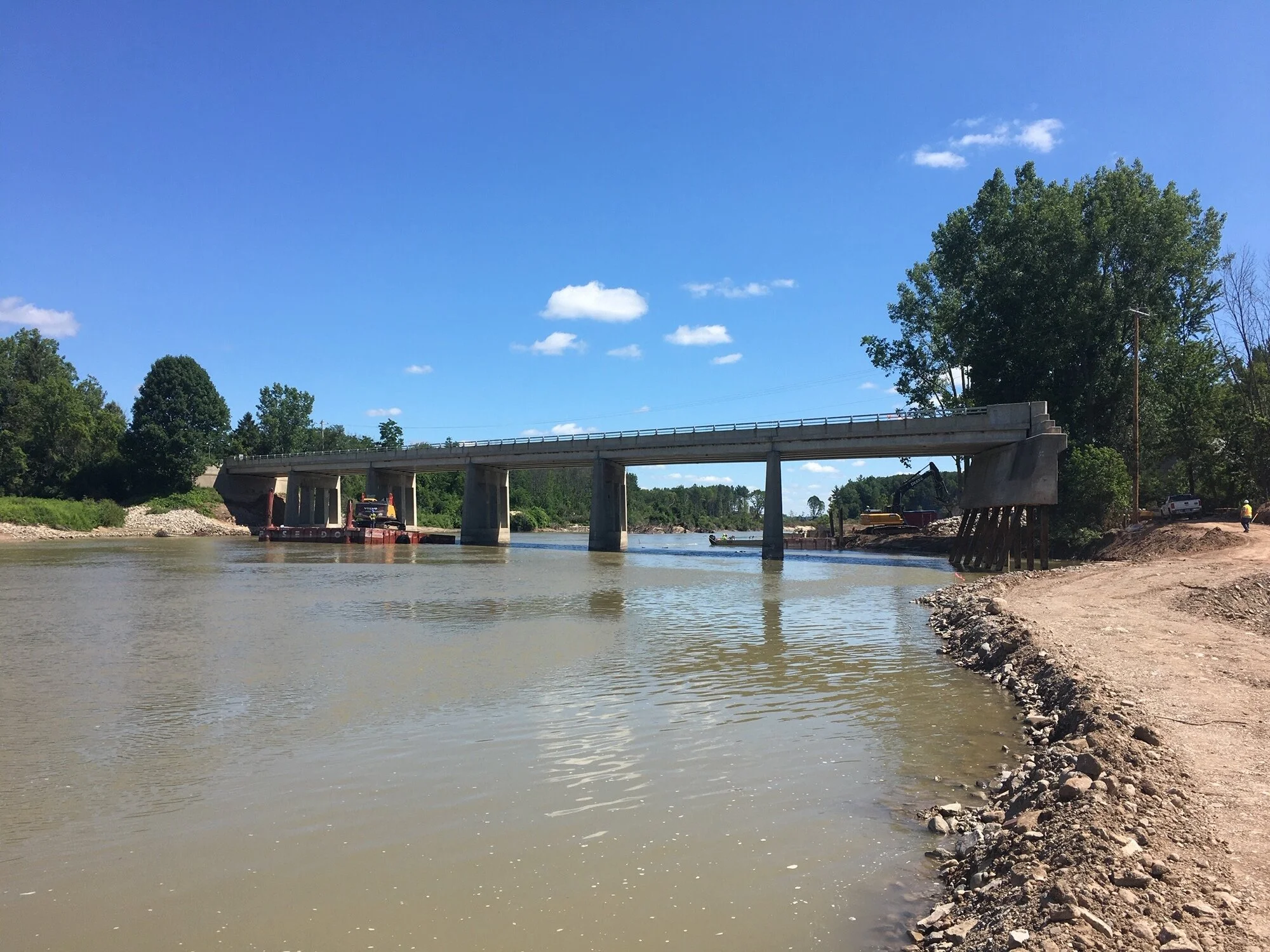
Photo 2: M-30 at the Tittabawassee River has been cleared of debris and emergency repairs to retrofit the existing piers and rebuild road and bridge approach begin Aug. 3.
M-30 flooding repairs in Midland and Gladwin counties begin June 29
Fast facts:- MDOT will administer an emergency debris removal contract to address the locations of two M-30 trunkline bridges damaged during the May flooding event.- Fisher Contracting has been awarded the emergency bid at $1.2 million and will begin work Monday, June 29.- Following debris removal, MDOT will move on to additional emergency contracts to address repairs to the M-30 structures over the Tittabawassee River and the Tobacco River.
June 29, 2020 -- The Michigan Department of Transportation (MDOT) has awarded an emergency contract to begin debris removal at two bridge locations on M-30 in Midland and Gladwin counties, following a historic flooding event in May.
M-30 structures over the Tittabawassee River in northern Midland County and over the Tobacco River in Gladwin County were both impacted by flooding. Midland-based Fisher Contracting was awarded the bid at $1.2 million and is expected to begin work Monday, June 29. Debris removal is expected to finish by July 22.
M-30 over the Tittabawassee River
The contractor will use a barge to remove existing debris and trees blocking the bridge piers.
Following debris removal, inspection of the existing piers will be completed and a maintenance plan established.
MDOT plans to administer an emergency contract to address required maintenance for the bridge and bridge approach, following complete review of the existing structure and determining repair options.
M-30 over the Tobacco River
The contractor will remove existing debris, including remaining pieces of the original causeway bridge washed away during the flood.
Following debris removal, inspection of the existing channel will begin and soil borings collected.
MDOT is currently working with temporary bridging solution vendors to determine an appropriate temporary bridge structure that will remain in place for several years while permanent bridge plans are established.
Following debris removal, MDOT will administer an emergency contract to begin construction of a temporary bridge at M-30 over the Tobacco River.
Photo 1: Debris removal at M-30 over the Tittabawassee River is expected to begin Monday, June 29, and will allow crews to begin necessary repairs of the existing bridge piers currently blocked by trees and other debris.
Photo 2: M-30 at the Tittabawassee River will also require inspection of the existing bridge approach, which will be rebuilt following inspections.
Photo 3: M-30 over the Tobacco River washed away in the flooding. Following debris removal, crews will begin construction of a temporary bridge.


